
DALY LK Vs LM BMS: Choosing 100A To 200A For Home Storage
Compare DALY 4th Gen LK and LM home energy storage BMS. Explore 100A, 150A and 200A options, 8S/16S configurations, balancing functions and inverter communication.
Home energy storage integrators evaluating battery management systems face a recurring question: how much continuous current does a given battery pack configuration actually need, and which communication interfaces will keep that pack talking reliably to the inverter? DALY addresses this question directly through its 4th Generation LK and LM Battery Management System models, two platforms purpose-built for home energy storage applications that support both Li-ion and LiFePO4 battery chemistries.
Why Home Energy Storage BMS Selection Is Complicated
Home energy storage battery packs require management that supports multiple battery chemistries and inverter communication protocols. Unlike single-purpose industrial battery systems, home storage installations must reconcile differing cell series counts, varying current demands across households, and a wide range of inverter brands with their own communication standards. DALY’s strategic positioning addresses exactly this gap by supplying configuration-customizable LK and LM BMS models with OEM/ODM services available for integrators who need a tailored solution rather than a one-size-fits-all board.
DALY LK and LM: Two Platforms, One Technology Base
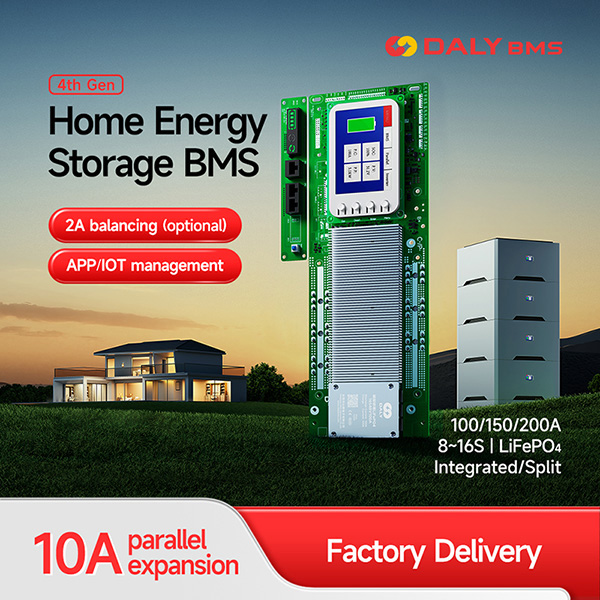
Both the DALY LK BMS and DALY LM BMS are built on DALY’s 4th Generation platform, which supports 8S and 16S battery series configurations and both Li-ion and LiFePO4 chemistries. The primary distinction between the two models lies in continuous current capability:
- LK BMS: continuous charge/discharge current of 100A, suited to home energy storage loads up to 100A continuous current.
- LM BMS: continuous charge/discharge current of 150A or 200A, suited to home energy storage loads up to 200A continuous current.
This current-based differentiation is the starting point for any selection decision. A household or integrator working with lower continuous draw requirements, or packs where 100A continuous throughput is sufficient, will find the LK BMS aligned with their needs. Installations demanding higher continuous throughput — up to 200A — are better matched to the LM BMS.
Balancing and Parallel Current Limiting: A Closer Look
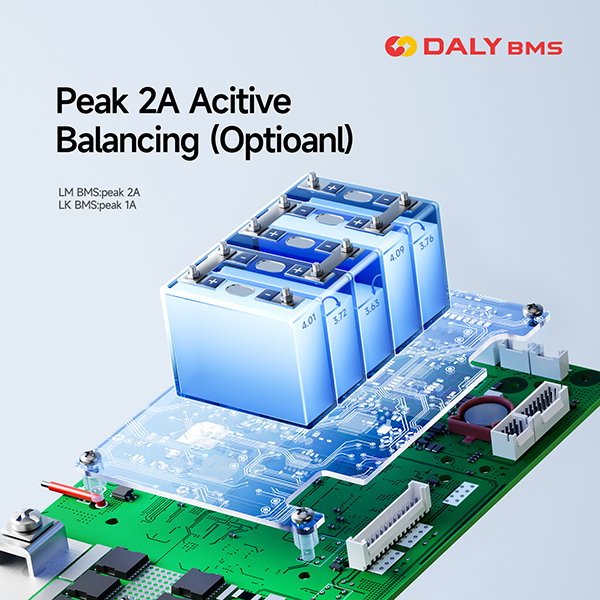
Beyond headline current ratings, both DALY home energy storage BMS models share a passive balancing current of 150mA. Where they diverge is in optional active balancing: the LK BMS offers an optional active balancing peak current of 1A, while the LM BMS offers an optional active balancing peak current of 2A. For integrators building packs that prioritize faster cell-level equalization, this distinction is worth factoring into the decision alongside raw current capacity.
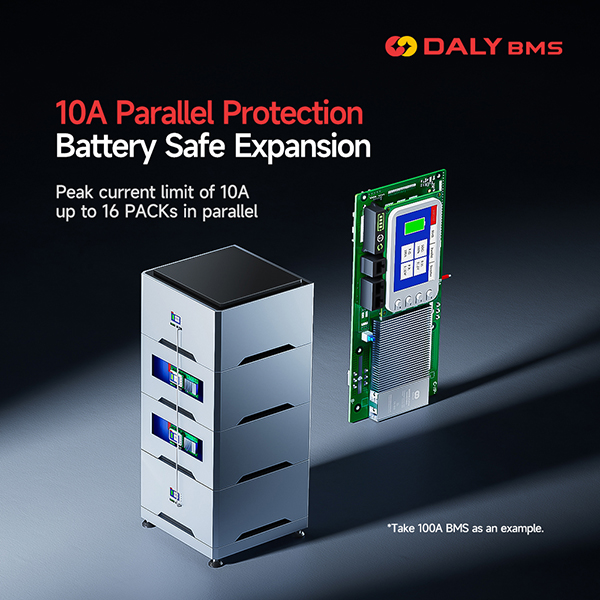
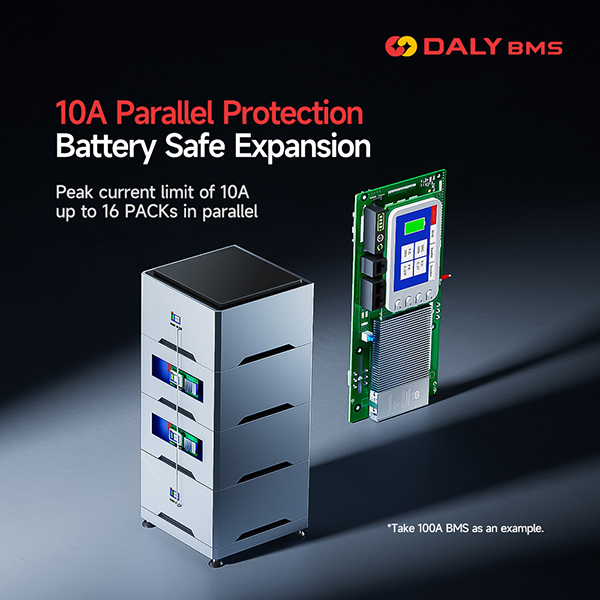
Parallel pack configurations also show differentiated specifications. Both models share a peak parallel current limiting of 10A, but continuous parallel current limiting differs: 2A continuous on the LK BMS and 3A continuous on the LM BMS. For multi-pack home energy storage arrays, this continuous parallel limit is a relevant consideration when sizing a system across several battery packs working in tandem.
Communication Architecture Shared Across Both Models
A notable point of consistency between the LK and LM BMS is their communication architecture. Both models provide mainboard communication through two UART ports and interface board communication through CAN and RS485. This shared architecture means that, regardless of which current rating an integrator selects, the underlying communication framework for connecting to an inverter remains the same.
Inverter Protocol Compatibility
Inverter communication compatibility is central to any home energy storage BMS decision, and DALY’s RS485 and CAN protocol compatibility lists are extensive. RS485 protocol inverter brands covered include Voltronic Power, Growatt, Sacolar, SRNE, Pylon, and Deye. CAN protocol inverter brands covered include Sacolar, Growatt, Victron, GoodWe, Solark, Xtender, SMA, Aiswei, Deye, SOFAR, and MUST.
It is important to understand the scope of this compatibility information accurately. The listed protocols have undergone parallel PACK testing and joint debugging, and this applies to the combinations covered by the supplied material — it should not be interpreted as universal compatibility with every inverter model. Compatibility depends on the specific inverter model, communication protocol, firmware, and configuration, so confirming the exact inverter model and communication requirements before purchase or integration remains a necessary step for any DALY ESS BMS deployment.
Optional Functions Available Across the Product Line
Beyond core current and communication specifications, the DALY home battery BMS product line offers a set of optional functions and accessories that can be added depending on the selected model and configuration. These include Bluetooth, Wi-Fi, a heating module, dry contact, key switch, RS485, and CAN, alongside supported functions such as UART, APP, PC, and IoT connectivity. Because exact availability of each option depends on the selected model and configuration, DALY recommends confirming the order configuration directly before finalizing a build.
Making the LK vs. LM Decision
In practical terms, choosing between the DALY LK BMS and DALY LM BMS comes down to three questions that integrators and installers should answer before placing an order:
- What continuous charge/discharge current does the pack require — up to 100A, or up to 150A/200A?
- Is 8S or 16S series configuration needed, since both models support either arrangement?
- Does the installation call for faster active balancing (1A on LK versus 2A on LM) or higher continuous parallel current limiting (2A on LK versus 3A on LM)?
Answering these questions, together with confirming the inverter brand, exact model, and required communication protocol, positions an integrator to select the correct DALY home ESS BMS configuration with confidence.
Customization, OEM/ODM, and Certification Support
For integrators whose requirements fall outside standard configurations, DALY offers customization across current specifications, communication protocols, hardware and structural design, software functions, and brand logo, along with OEM/ODM services. The pre-sale process is structured so that customers provide battery chemistry, number of cells in series, required continuous charge/discharge current, inverter brand and exact model, required communication protocol, parallel battery-pack requirements, desired optional functions, and any hardware, structural, software, or branding customization needs. DALY then confirms the final model, configuration, and inverter communication compatibility before order placement. Feasibility, technical parameters, development scope, and lead time are confirmed for each individual customization request.
DALY can also provide documentation to support customer certification projects. This documentation support does not state or imply that the LK or LM model has obtained any specific certification or approval — a distinction worth noting for integrators managing their own compliance pathways.
Need Help Choosing Between DALY LK and LM BMS?
Choosing the right home energy storage BMS requires more than comparing current ratings. Battery chemistry, series configuration, continuous charge and discharge current, inverter communication, and parallel battery requirements should all be considered.
DALY provides the 4th Generation LK and LM BMS options for 8S and 16S Li-ion and LiFePO4 battery applications, with different current ratings and optional functions.
For customized home energy storage projects, DALY also supports current specification customization, communication protocol customization, hardware and structural customization, software function customization, and OEM/ODM branding.
Contact DALY with the following project details to discuss a suitable configuration:
-
Battery chemistry: Li-ion or LiFePO4
-
Battery series configuration: 8S or 16S
-
Required continuous charge/discharge current
-
Inverter brand and exact model
-
Communication protocol: CAN or RS485
-
Parallel battery configuration requirements
-
Customization or OEM/ODM requirements
Our team can review your application requirements and confirm the appropriate model, configuration, and technical feasibility for your project.
Related products
-

01072-081-HS25 Series Incremental Encoder-BEI sensors
Contact UsHS25 combines the rugged, heavy-duty features usually associated with shafted encoders into a hollow-shaft style. Its design includes dual bearings and seals for up to IP65 environmental ratings…
-

BM210A
Contact UsThe BM210A is a high-performance Battery Management System (BMS) designed for lithium battery packs.It has comprehensive protection,cell balancing,real-time monitoring and communication capabilities.
-

Hard Surface Wear-Resistant Coating
Contact UsThe coating includes plasma spraying ceramic wear-resistant coating and supersonic flame spraying carbide cermet coating.
-

S11/13/20/22 Oil-immersed transformers
Contact UsThe product has the characteristics of high efficiency and low loss, which can save a lot of electricity consumption and operating costs
Reviews
There are no reviews yet.