
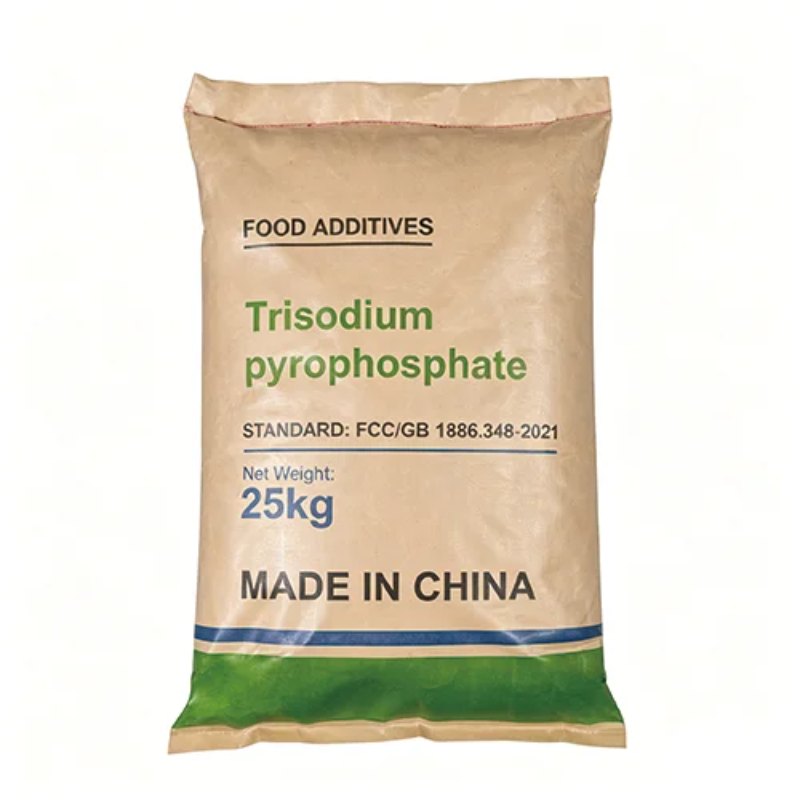
TSAPP – Trisodium Acid Pyrophosphate
Food-grade TSAPP provides pH buffering, moisture retention, and protein stabilization for food formulations.
1. Product Introduction
TSAPP – Trisodium Acid Pyrophosphate is a specialized phosphate ingredient also known as trisodium hydrogen pyrophosphate. With an intermediate acid-base profile between sodium acid pyrophosphate (SAPP) and tetrasodium pyrophosphate (TSPP), it offers food formulators an additional option for controlling acidity and improving formulation stability.
Food-grade TSAPP is used primarily as a moisture-retaining agent and acidity regulator in selected food applications. Its buffering properties and moderate chelating capacity make it suitable for formulations that require controlled pH conditions, particularly dairy-based beverages, flavored milk, sauces, and condiments.
In liquid dairy applications, appropriate phosphate selection can help manage protein stability and reduce the risk of sedimentation. TSAPP can also be incorporated into customized leavening systems to help adjust the acid balance according to specific processing and product requirements.
Supplied in white powder or granular form, this product is available for food ingredient manufacturers, beverage producers, seasoning companies, and chemical distributors. Material specifications, application suitability, and regulatory compliance should be confirmed according to the intended use and destination market.
2. Key Product Features and Advantages
1. Effective pH Buffering
TSAPP helps adjust and maintain acidity within a target range, making it useful in food formulations where pH control affects product quality, stability, and processing performance.
2. Moisture Retention Support
As a phosphate ingredient, TSAPP can contribute to moisture management in suitable food systems. Its performance depends on the overall formulation, processing conditions, and dosage.
3. Protein Stability in Dairy Beverages
TSAPP can be considered for dairy-based drinks and flavored milk formulations where protein dispersion and resistance to sedimentation are important. Application testing is recommended to establish the appropriate formulation and dosage.
4. Flexible Formulation Options
With an acid-base profile between SAPP and TSPP, TSAPP offers formulators another option for developing phosphate blends with specific buffering and processing characteristics.
5. Multiple Food Application Possibilities
Potential applications include dairy beverages, sauces, condiments, and customized leavening blends, subject to applicable food regulations and formulation requirements.
6. Convenient Bulk Packaging
Standard packaging options include 25 kg bags and 1,000 kg jumbo bags. Customized packaging and pallet configurations can be discussed according to order volume and logistics requirements.
7. Specification and Documentation Support
Technical documentation, including TDS, SDS, and Certificate of Analysis (CoA), can be provided subject to product availability and order requirements.
3. Product Specifications
| Parameter | Food Grade TSAPP |
|---|---|
| Product Name | TSAPP – Trisodium Acid Pyrophosphate |
| Alternative Name | Trisodium Hydrogen Pyrophosphate |
| Molecular Formula | Na₃HP₂O₇ |
| Molecular Weight | 243.92 g/mol |
| CAS Number | 14691-80-6 |
| Appearance | White powder or granular |
| Product Grade | Food Grade |
| Reference Standards | GB 1886.348-2021, FCC, E450(ii), subject to applicable product specification and regulatory requirements |
| Main Content | According to confirmed FCC/GB specification |
| Water-Insoluble Matter | According to confirmed product specification |
| pH Value (10 g/L Solution) | According to confirmed product specification |
| Standard Packaging | 25 kg bags |
| Bulk Packaging | 1,000 kg jumbo bags |
| Customized Packaging | Available upon confirmation |
Note: Exact chemical assay, water-insoluble matter limits, pH range, and other acceptance criteria should be confirmed against the current technical specification and batch CoA before ordering. Regulatory status and permitted uses may vary by market.
4. Typical Applications
Dairy Beverages and Flavored Milk
TSAPP can be evaluated as a buffering phosphate in dairy-based beverages where pH management and protein stability are important. The final formulation should be tested to determine its effect on dispersion, sedimentation, and storage stability.
Food Processing and Moisture Management
In suitable food systems, TSAPP may contribute to moisture retention and formulation control. Its effectiveness depends on the food matrix, processing method, dosage, and interactions with other ingredients.
Sauces and Condiments
TSAPP can be used in selected sauces, prepared condiments, and seasoning formulations to support acidity adjustment and product consistency, where permitted by local food regulations.
Customized Leavening Systems
For baking ingredient manufacturers, TSAPP can be considered as part of a customized phosphate blend. Its use depends on the desired acid balance, reaction characteristics, processing conditions, and finished-product requirements.
Phosphate Blends
TSAPP may be combined with other phosphate ingredients, such as sodium tripolyphosphate (STPP) or disodium phosphate (DSP), when technically suitable. Compatibility, functional performance, dosage, and regulatory requirements should be evaluated for each application.
5. TSAPP vs. SAPP vs. TSPP
These phosphate ingredients have different chemical compositions and acid-base characteristics, so they are not automatically interchangeable.
| Comparison | TSAPP | SAPP | TSPP |
|---|---|---|---|
| Full Name | Trisodium Acid Pyrophosphate | Sodium Acid Pyrophosphate | Tetrasodium Pyrophosphate |
| Chemical Formula | Na₃HP₂O₇ | Na₂H₂P₂O₇ | Na₄P₂O₇ |
| Acid-Base Profile | Intermediate | Acidic | More alkaline |
| Potential Formulation Role | pH buffering and formulation adjustment | Acid component in suitable food formulations | Phosphate ingredient for applications requiring its specific functional properties |
| Selection Considerations | Target pH, stability, and application needs | Leavening reaction and acidity requirements | Alkalinity, functional requirements, and regulatory suitability |
The actual pH of a solution depends on concentration, temperature, and test conditions. Formulators should consult the relevant technical data and test the ingredient in the intended recipe rather than relying on a generic pH value.
6. Packaging and Storage
Available Packaging
-
25 kg bags for standard industrial and food ingredient orders
-
1,000 kg jumbo bags for bulk purchasing
-
Customized packaging and pallet configurations upon confirmation
Storage Recommendations
Store the product in a cool, dry, well-ventilated area, protected from moisture and contamination. Keep packaging properly sealed when not in use and follow the handling, storage, and shelf-life instructions provided in the current product documentation.
For food-grade applications, use suitable handling procedures to maintain product integrity and prevent contamination during storage, transportation, and production.
7. Why Choose Waking Lion?
Established Phosphate Manufacturing Expertise
Wuhan Waking Lion Chemicals Co., Ltd. is a wholly owned subsidiary of Wuhan Liande Chemicals Co., Ltd., responsible for international trade and export operations. The wider business has a long history in phosphate production and chemical manufacturing.
Large-Scale Production Resources
The company reports annual phosphoric acid production capacity of 150,000 metric tons and fine phosphate production capacity of 200,000 metric tons. These production resources support its broader phosphate product portfolio; the specific TSAPP capacity and availability should be confirmed when requesting a quotation.
International Quality Certifications
The company reports holding ISO 9001, ISO 22000, ISO 14001, ISO 45001, ISO 50001, BRC, HALAL, and KOSHER certifications. Buyers should confirm the applicable certification scope and current validity for the product and destination market.
International Export Experience
With products distributed across more than 50 countries and regions, the company serves customers in Europe, the Americas, Southeast Asia, and the Middle East. Its export operations support international procurement and chemical distribution requirements.
Technical Documentation Support
Depending on the product and order, the company can provide relevant technical documentation, including TDS, SDS, CoA, and customs-related documents. Specific documentation requirements should be confirmed before shipment.
Packaging and Supply Coordination
Packaging formats, pallet arrangements, order quantities, and delivery schedules can be discussed according to the buyer's requirements and confirmed supply conditions.
8. Supplier Information
Wuhan Waking Lion Chemicals Co., Ltd. is headquartered in Wuhan, China, and specializes in international trade and export operations for a broad range of chemical products. As part of the Wuhan Liande Chemicals business, it benefits from established phosphate production resources, technical expertise, and an international sales network.
The wider company operates facilities covering approximately 200,000 square meters and employs more than 400 people, including nearly 100 technical professionals. Its product portfolio includes sodium and potassium salts across multiple grades, as well as inorganic chemical raw materials, agricultural fertilizers, chemical reagents, and food additives.
With substantial phosphate production capacity and an integrated technology center for research, development, and production, the company continues to develop its chemical product portfolio and serve customers in domestic and international markets.
For buyers sourcing TSAPP – Trisodium Acid Pyrophosphate, the supplier can discuss product specifications, packaging options, documentation, and export arrangements according to the intended application and order requirements.
9. Frequently Asked Questions
Q1: What is TSAPP used for?
TSAPP is a phosphate ingredient used in selected food formulations for pH buffering, acidity adjustment, moisture management, and other application-specific functions. Potential uses include dairy beverages, sauces, condiments, and customized leavening blends, subject to local regulatory requirements.
Q2: What is the difference between TSAPP, SAPP, and TSPP?
They differ in sodium content, chemical composition, and acid-base characteristics. SAPP is an acidic pyrophosphate, TSPP is a more alkaline pyrophosphate, and TSAPP has an intermediate composition. The appropriate ingredient depends on the target pH, processing conditions, and desired functional properties.
Q3: Can TSAPP be blended with other phosphates?
Yes, it may be considered for blending with other phosphate ingredients, including STPP or DSP, when technically appropriate. Formulation trials should confirm compatibility, performance, dosage, and compliance with applicable food regulations.
Q4: What packaging options are available?
Standard options include 25 kg bags and 1,000 kg jumbo bags. Other packaging or pallet configurations may be discussed according to order quantity and logistics requirements.
Q5: Can you provide technical documents?
Relevant documents, such as TDS, SDS, and CoA, can be requested. Availability and document details should be confirmed for the specific product and shipment.
Q6: How can I request a quotation?
Provide the required quantity, destination market, packaging preference, intended application, applicable standards, and documentation requirements. The supplier can then confirm the available specifications, pricing, delivery schedule, and shipping arrangements.
10. Request a Quotation
If you are sourcing food-grade phosphate ingredients for beverage manufacturing, food processing, or customized formulations, contact Wuhan Waking Lion Chemicals Co., Ltd. with your technical and purchasing requirements.
Please specify the intended application, order quantity, packaging preference, destination country, and required quality standards. Product availability, detailed specifications, pricing, and lead time will be confirmed according to your inquiry.
Choose TSAPP – Trisodium Acid Pyrophosphate for food formulation projects that require carefully managed phosphate functionality and application-specific pH control.
Related products
-
Büngener Antarctic Krill Fish Oil
Contact UsOptimal Omega-3 fatty acid balance for promoting overall health and well-being
-
-

Büngener Meatonly Tetra Recart Wet Food – COUNTRY CHICKEN
Contact UsChicken 50%, Chicken broth 46%, Minerals 0.05%.
-
Hijiki Seaweed
Contact UsHijiki seaweed is a warm-temperate to subtropical seaweed, characterized by its upright, branched, and yellowish-brown algae body. Dried hijiki is made by sun-drying or dehydrating fresh hijiki
Reviews
There are no reviews yet.