
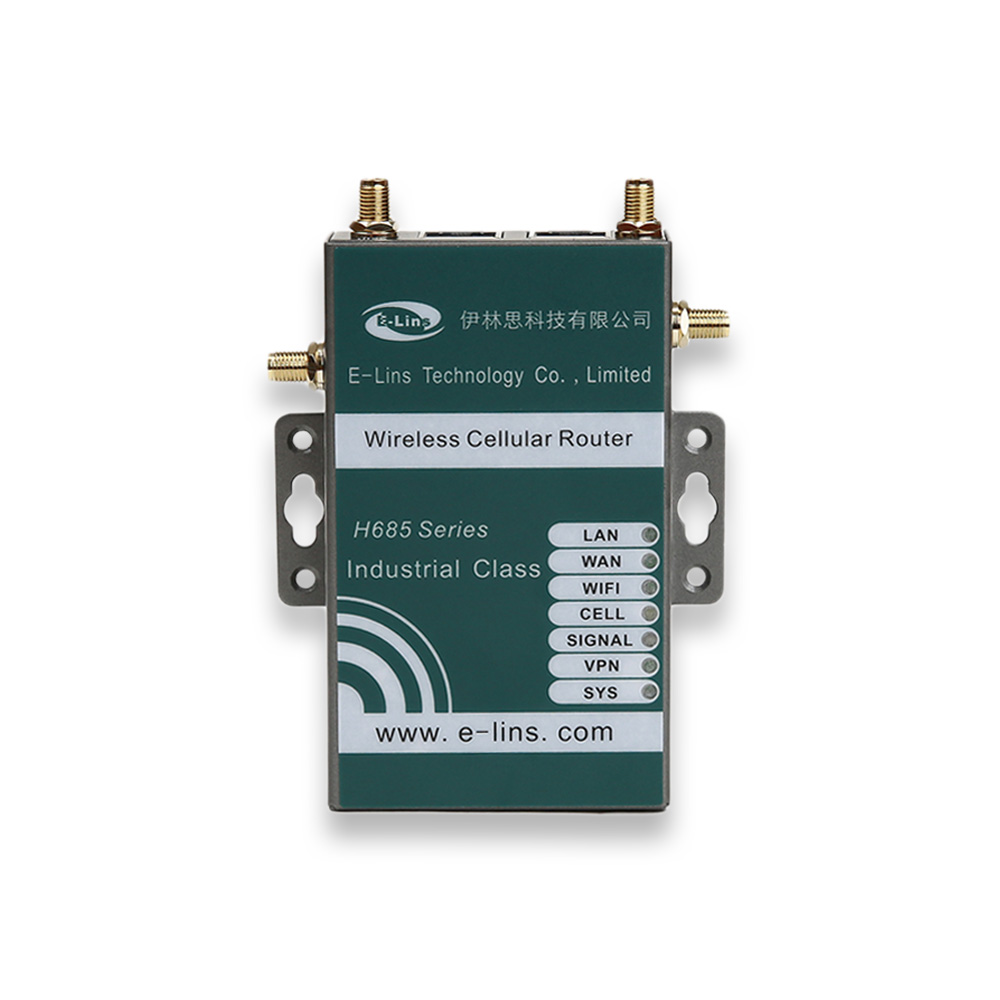
How Engineers Choose Recommended Industrial 4G Router Manufacturers for Tenders: Writing Performance Specifications That Lead to Reliable Suppliers
Shenzhen E-Lins Technology Co., Ltd., with industrial roots dating back to 1999 and customers in more than 150 countries and regions.
When a consultant or project engineer recommends an industrial 4G router manufacturer, the recommendation often ends up in a tender document. That creates a dilemma. Public and many private procurement rules discourage or prohibit specifying a brand. Yet a loosely written specification invites the cheapest box that technically complies, which may be the wrong router for remote, unattended sites.
The answer is a performance specification: a set of requirements written so precisely that only suitable products and suppliers can meet them, without naming any brand. This article explains how engineers can write such specifications for industrial 4G routers, gives example clauses, and shows how a manufacturer such as E-Lins can demonstrate compliance.
Why Performance Specifications Instead of Brand Names
Procurement rules in many jurisdictions, including the European Union’s public procurement framework, generally prevent technical specifications from referring to a specific make or brand unless this is justified and accompanied by the words “or equivalent”. Even where rules are looser, brand-based specifications age badly: models change, and the specification becomes impossible to meet. Performance clauses describe what the router must do, which remains valid as products evolve.
Example Clauses for an Industrial 4G Router Specification
The clauses below are examples. Adjust values to the project.
Environmental
“The router shall operate continuously across an ambient temperature range of at least -30°C to +70°C.”
“Ethernet and serial ports shall be protected against electrostatic discharge, with the protection level stated in the offer.”
Power
“The router shall accept a DC input range covering the site supply with margin, shall be protected against reverse polarity and transients, and shall restart automatically after any power interruption without manual intervention.”
“For critical sites, the router shall provide two power inputs with automatic failover.”
Cellular
“The router shall support the LTE bands used by the nominated operators at the installation sites. The bidder shall state the LTE category and the supported bands for the offered variant.”
“For critical sites, the router shall support two SIM cards with automatic failover between operators.”
Interfaces and protocols
“The router shall provide [number] Ethernet ports, [number] RS232/RS485 ports with transparent transmission, and [number] digital inputs and outputs.”
“The router shall support Modbus communication with the existing field devices.”

Security
“The router shall establish encrypted tunnels to the existing head-end using at least one of IPsec, OpenVPN, or WireGuard, and shall support operation with no management services exposed on the cellular interface.”
“The bidder shall describe how security vulnerabilities are handled and how firmware updates are delivered over the life of the equipment.”
Management
“The router shall support remote monitoring and configuration through standard protocols, including SNMP and TR-069, and remote firmware upgrade.”
Supplier capability
“The bidder shall provide technical support covering 24 hours a day, 7 days a week, state its average response time, and provide firmware updates for the expected service life without additional licence fees.”
“The bidder shall provide evidence of at least one deployment of comparable scale and conditions, with measured availability.”
Compliance
“The equipment shall carry the conformity markings required for the installation country, such as CE or UKCA, and comply with RoHS. Declarations of conformity shall be provided with the offer.”
How a Manufacturer Demonstrates Compliance
Good bidders answer performance clauses with a compliance matrix: one row per clause, a clear “complies” or “does not comply”, and the evidence. Using E-Lins’s published information as an example:
|
Clause area |
E-Lins evidence |
|
Environmental |
Components rated -35°C to +75°C; 15KV ESD protection; 1.5KV electromagnetic isolation |
|
Power |
5 to 40V DC standard, 5 to 60V DC option, dual inputs with failover on models such as the H900t; transient and reverse-polarity protection; watchdog and link self-healing |
|
Cellular |
Dual SIM on the H900t; dual LTE on the H700 and H750tt; band list per variant to be confirmed |
|
Interfaces |
Ethernet, RS232/RS485 with transparent transmission, DI/DO depending on model; Modbus support |
|
Security |
WireGuard, IPsec and OpenVPN, with L2TP, GRE and DMVPN listed across routers; firmware developed in-house |
|
Management |
TR-069, SNMP, SSH; E-Lins NMS with remote firmware upgrade |
|
Supplier capability |
7×24 support; 10-minute average response in business hours; lifetime free firmware upgrades; 100,000+ unit deployment at 99.4% online |
|
Compliance |
CE, FCC, UKCA; RoHS; ISO 9001 and ISO 14001 |
Evaluating Bids Fairly
Score evidence, not statements. A “complies” without evidence should score lower than one backed by documents or test results.
Request samples from shortlisted bidders and test the clauses that matter most, such as power recovery and VPN interoperability.
Weigh supplier capability properly. Support, firmware maintenance, and field evidence determine long-term costs.
Keep the specification current. Review it when regulations change; for example, European cybersecurity requirements for radio equipment have applied since 1 August 2025, and Cyber Resilience Act obligations continue to phase in through 2027.
Specifying for the Whole Service Life
Industrial routers often stay in service for many years, so a good specification looks beyond installation day. Ask bidders to state how long firmware updates will be provided, how hardware revisions will be communicated, how spare units will be supplied over the contract period, and how end-of-life will be handled. These clauses rarely change the purchase price, but they strongly affect the cost and risk of operating the network, and they help the evaluation team distinguish suppliers who plan for the long term from those who only plan for the delivery.
Common Specification Mistakes
Copying a datasheet. A specification copied from one product’s datasheet effectively names that product and excludes equivalent alternatives.
Specifying features nobody needs. Every unnecessary requirement raises cost and narrows competition without improving the network.
Leaving out the supplier. Many specifications describe the device in detail but say nothing about support, firmware maintenance, or field evidence, which decide long-term cost.
Using vague words. “Industrial grade” or “high reliability” cannot be evaluated. Replace them with measurable values.
Ignoring the sites. A clause that suits a city office may be wrong for a pole in a desert. Base values on the harshest site in the project.
Writing the Evaluation Criteria
The specification decides who may bid; the evaluation criteria decide who wins. Weight technical compliance, supplier capability, and price explicitly, and state how evidence will be scored. Publishing the criteria with the tender encourages bidders to provide evidence rather than claims, and makes the final recommendation easier to defend.
From Specification to Recommendation
A well-written performance specification lets engineers recommend suitable industrial 4G router manufacturers without naming them, by making the requirements that matter explicit. Manufacturers that can answer every clause with evidence rise naturally to the top. Shenzhen E-Lins Technology Co., Ltd., with industrial roots dating back to 1999 and customers in more than 150 countries and regions, publishes the information needed to complete such a compliance matrix, and bidders can request model-specific documents from its team.
Related products
-
Electric Vehicle Application
Contact UsLaminated busbar is a connection bar with a multi-layer composite structure.
-

5G Industrial Router with RS485: E-Lins H900f Delivers Reliable Connectivity
Contact UsE-Lins Technology has validated its solutions through demanding real-world deployments across diverse industrial verticals.
-

8W VTX
Contact UsMOQ: 100set
Payment: T/T
Shipment: 30 days for regular products, except customized
Customized Service: Support(Color, Logo, Packaging)
Qualification: ISO2009 -

Reviews
There are no reviews yet.