
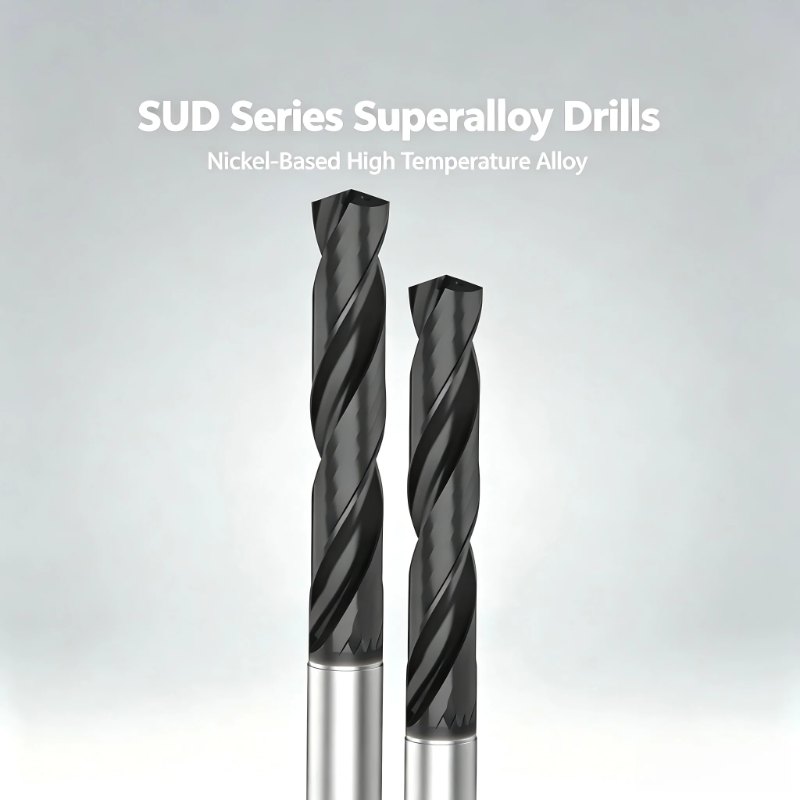
High Temperature Alloy Carbide Drill Bits | 1-20mm 3XD 5XD Coolant Through
Solid carbide drills with internal coolant holes for precision machining of nickel and titanium alloys.
1. Product Introduction
The High Temperature Alloy Carbide Drill Bits | 1-20mm 3XD 5XD Coolant Through are designed for CNC drilling of difficult-to-machine materials, including nickel-based alloys, titanium alloys, and heat-resistant stainless steels. Manufactured from ultra-fine-grain solid carbide, these drills combine wear resistance, cutting-edge strength, and precision-ground geometry for demanding industrial machining operations.
Available in diameters from 1.0 mm to 20.0 mm, with 3XD and 5XD length options, the drills feature internal coolant holes to deliver coolant toward the cutting zone. This design helps manage cutting heat, support chip evacuation, and improve drilling stability, particularly when machining heat-resistant alloys and deeper holes.
With application-specific coatings, optimized cutting geometry, and standard or customized configurations, the series supports precision drilling in aerospace components, turbine parts, energy equipment, and other applications where material toughness and work hardening create machining challenges.
Changzhou Boston Tool Co., Ltd. manufactures precision cutting tools, including solid carbide drills, milling cutters, reamers, and customized special tools. Standard and non-standard tool requirements can be discussed according to workpiece material, hole dimensions, and production conditions.
2. Key Product Features and Advantages
Ultra-Fine-Grain Solid Carbide Substrate
The carbide substrate is designed to balance hardness, toughness, and wear resistance. These properties help the cutting edges withstand the demanding conditions associated with nickel-based alloys and titanium alloys. Actual tool performance depends on the workpiece grade, hardness, machine rigidity, and cutting parameters.
High-Temperature-Resistant Coating Options
The specified coating system is designed to improve oxidation resistance, reduce friction, and limit material adhesion at the cutting edge. Appropriate coating selection can help reduce built-up edge formation and wear when machining difficult-to-cut alloys.
Optimized Cutting-Edge Geometry
The point geometry and edge preparation are designed to balance cutting sharpness and edge strength. This helps manage cutting resistance and supports stable drilling in materials that may work-harden during machining.
Internal Coolant Hole Design
Internal coolant channels deliver coolant toward the cutting zone, helping remove heat and assist chip evacuation. The design is particularly relevant to deeper drilling operations, where heat accumulation and chip removal can affect tool life and hole quality.
3XD and 5XD Configurations
The available length options support different hole-depth requirements. A 3XD drill is intended for relatively shallower holes, while a 5XD configuration accommodates greater drilling depth relative to the tool diameter. Actual usable depth depends on the tool design and machining setup.
Precision Grinding and Dimensional Consistency
Precision CNC grinding helps maintain consistent tool geometry. The product information specifies H7-grade hole precision as a potential machining result, but the achieved hole tolerance depends on the machine, tool condition, workholding, material, and machining process.
Standard Sizes and Customization
The stated diameter range is 1.0–20.0 mm. Customized diameter, overall length, flute length, point angle, coating, and other specifications can be discussed for application-specific requirements.
3. Product Technical Specifications
| Parameter | Specification |
|---|---|
| Product Name | High Temperature Alloy Carbide Drill Bits |
| Tool Material | Ultra-fine-grain solid carbide |
| Diameter Range | 1.0–20.0 mm |
| Standard Length Options | 3XD and 5XD |
| Coolant Design | Internal coolant holes |
| Coating | High-temperature-resistant composite coating; exact grade to be confirmed |
| Applicable Materials | Nickel-based alloys, titanium alloys, Inconel, Hastelloy, Monel, heat-resistant stainless steel |
| Machining Operations | CNC drilling and deep-hole drilling within the recommended tool range |
| Hole Tolerance | H7-grade hole accuracy may be achievable under suitable conditions |
| Cooling Options | Internal coolant delivery; wet cutting and MQL compatibility to be confirmed for the selected configuration |
| Compatible Equipment | CNC machining centers and compatible CNC drilling equipment |
| Customization | Diameter, length, flute length, point angle, coating, and other options subject to technical confirmation |
| Supply Type | Standard and customized products |
Technical note: The product description refers to internal coolant holes and also lists dry cutting, wet cutting, MQL, and air-blow cooling. These methods are not interchangeable in every application. Confirm the coolant-hole configuration, recommended coolant pressure and flow, and approved operating method for the selected tool before use.
4. Compatible Materials
The drills are intended for demanding metalworking applications involving:
-
Nickel-based superalloys
-
Titanium alloys
-
Inconel alloys
-
Hastelloy alloys
-
Monel alloys
-
Heat-resistant stainless steel
-
Other suitable high-temperature alloys
Machinability varies considerably between alloy grades and heat-treatment conditions. For high-strength or work-hardened materials, verify the recommended tool grade, coating, cutting speed, feed rate, and coolant strategy before production machining.
5. Typical Industrial Applications
Aerospace Manufacturing: Drilling suitable heat-resistant alloy components used in aircraft structures, engine assemblies, and other precision parts.
Turbine and Engine Components: Machining compatible high-temperature alloy parts where heat resistance and dimensional consistency are important.
Energy Equipment: Drilling suitable components for power-generation and other demanding industrial equipment.
Petrochemical Equipment: Machining compatible alloy components used in valves, pressure equipment, and industrial fluid systems.
Heavy Machinery: Precision drilling in suitable high-strength alloy parts.
Precision Manufacturing: CNC hole machining for components that require controlled dimensions and reliable batch consistency.
Application suitability should be verified against the actual workpiece material, hole geometry, equipment capability, and required surface finish.
6. Recommended Cutting Parameters
The following values are reproduced from the supplied preliminary cutting data. They should be treated as starting references, not guaranteed settings for every tool, machine, or alloy grade.
| Drill Diameter (mm) | Titanium Alloy Speed (rpm) | Titanium Alloy Feed (mm/rev) | Inconel Speed (rpm) | Inconel Feed (mm/rev) |
|---|---|---|---|---|
| 4 | 1500 | 0.04–0.06–0.08 | 1200 | 0.04–0.06–0.08 |
| 6 | 1060 | 0.05–0.08–0.10 | 780 | 0.05–0.08–0.10 |
| 8 | 750 | 0.06–0.09–0.11 | 600 | 0.06–0.09–0.11 |
| 10 | 630 | 0.07–0.10–0.12 | 480 | 0.07–0.10–0.12 |
| 12 | 550 | 0.07–0.10–0.12 | 340 | 0.07–0.10–0.12 |
Feed values are presented as minimum–recommended–maximum, in mm/rev.
The supplied general cutting-speed reference for titanium and Inconel alloys is 10–20–30 m/min. However, the table lists specific spindle speeds for selected diameters. Because spindle speed depends on tool diameter and cutting speed, confirm that the selected values are appropriate for the actual alloy grade and tool configuration before machining.
For diameters not listed, as well as other superalloy grades, request application-specific cutting data from the supplier.
7. Operating Recommendations
To improve drilling stability and help extend tool life, consider the following practices:
-
Verify coolant delivery: Ensure that the internal coolant passages are compatible with the machine connection and that the coolant supply meets the tool's requirements.
-
Use stable clamping: Secure the workpiece and tool properly to reduce vibration and positional deviation.
-
Minimize tool overhang: Keep unsupported tool length as short as practical for the required hole depth.
-
Control chip evacuation: Use a suitable drilling cycle for the material and depth. Peck drilling may be necessary when chip evacuation is difficult, subject to the tool manufacturer's guidance.
-
Match cutting parameters to the alloy: Avoid applying general-purpose steel parameters to nickel-based or titanium alloys without verification.
-
Monitor tool wear: Inspect the cutting edges and machined holes periodically, particularly during initial process validation.
-
Confirm the coolant method: Use wet cutting or MQL only where compatible with the tool configuration and machining recommendations.
The optimal machining strategy depends on hole depth, alloy condition, coolant pressure, machine rigidity, and the required surface finish.
8. Customization and OEM/ODM Options
Changzhou Boston Tool Co., Ltd. offers precision cutting tool manufacturing and can discuss customized requirements for suitable applications.
Potential customization options include:
-
Non-standard drill diameters
-
Customized overall length and flute length
-
Special point angles and cutting-edge geometry
-
Alternative coating options
-
Application-specific tool configurations
-
Customer logo marking and customized packaging, subject to confirmation
To evaluate a custom requirement, provide the workpiece material and hardness, hole diameter, hole depth, machine model, coolant arrangement, required tolerance, and estimated quantity. Technical drawings are recommended for non-standard tools.
9. Frequently Asked Questions
Q1: Why are specialized carbide drills recommended for high-temperature alloys?
Nickel-based and other heat-resistant alloys can generate high cutting temperatures, resist deformation, and work-harden during machining. These conditions can accelerate tool wear and increase the risk of chipping or unstable drilling. A suitable carbide substrate, coating, and cutting geometry can help address these challenges.
Q2: Can these drills machine titanium and nickel-based alloys?
They are designed for applications involving titanium alloys, nickel-based alloys, and selected heat-resistant materials. Confirm the exact alloy grade, workpiece hardness, hole depth, and tool specification to establish suitable cutting parameters.
Q3: What is the advantage of internal coolant holes?
Internal coolant delivery directs coolant toward the cutting zone, helping manage heat and remove chips. It can be especially beneficial in deeper holes, where external coolant may not reach the cutting edge effectively. Performance depends on coolant pressure, flow, fluid selection, and tool design.
Q4: What is the difference between 3XD and 5XD?
The X designation expresses flute or drilling length relative to the nominal tool diameter. A 3XD option is generally intended for shallower holes, while 5XD supports greater depth. Confirm the manufacturer's definition of usable drilling depth and the recommended drilling cycle for the selected model.
Q5: What diameter sizes are available?
The stated diameter range is 1.0–20.0 mm. Standard availability and stock status should be confirmed at the time of inquiry. Non-standard dimensions may be considered subject to manufacturing feasibility.
Q6: Can I request a customized drill?
Yes, customization can be discussed for diameter, length, flute length, point geometry, coating, and other application requirements. Logo marking and special packaging should also be confirmed before order placement.
Q7: What is the MOQ and delivery time?
The supplied information lists a minimum order quantity of two pieces for standard sizes, estimated delivery of 3–5 working days for in-stock products, and 7–15 working days for customized products. These are indicative figures and require confirmation based on inventory, specifications, and order quantity.
Q8: How can I obtain the correct cutting parameters?
Provide the tool diameter, hole depth, workpiece alloy grade, material hardness, machine specifications, coolant arrangement, and required hole tolerance. The supplier can then help evaluate an appropriate tool configuration and preliminary cutting parameters.
10. Manufacturing Capabilities
Changzhou Boston Tool Co., Ltd. was founded in 2013 and specializes in the research, development, production, sales, and service of precision metal-cutting tools. Its product range includes solid carbide drills, milling cutters, reamers, and customized special tools.
The company reports using more than 20 imported precision grinding machines from SAACKE and WALTER, together with an MES system for production process management. Its manufacturing processes include precision grinding, cutting-edge treatment, coating, and finished-product inspection.
With experience in OEM manufacturing and customized tooling, the company aims to support machining factories, distributors, and industrial buyers with standard tools and application-specific solutions. Technical assistance for tool selection and machining optimization can be discussed according to project requirements.
11. Packaging, Shipping, and Order Information
Packaging: Protective packaging suitable for the product and agreed transportation method. Special packaging requirements should be confirmed before shipment.
Delivery Time: Depends on the selected specifications, quantity, current inventory, and customization requirements.
Shipping: Shipping methods, loading port, freight responsibilities, and insurance arrangements should be specified in the quotation or sales contract.
Inspection: Inspection standards, dimensional acceptance criteria, and required documentation should be agreed upon before production.
Payment: Payment methods and schedules should be confirmed in the sales contract.
Returns and Exchanges: Return eligibility, handling charges, and replacement arrangements should be stated clearly in the agreed commercial terms. Customized products may be subject to different conditions.
Before ordering, buyers should confirm the final tool specification, coating, dimensions, coolant requirements, quantity, delivery schedule, payment terms, and quality acceptance procedures.
12. About the Manufacturer
Changzhou Boston Tool Co., Ltd. is a precision cutting tool manufacturer based in Changzhou, China. Established in 2013, the company focuses on carbide drills, milling cutters, reamers, and customized metal-cutting tools for industrial manufacturing.
Its manufacturing approach combines carbide raw material selection, precision grinding, coating processes, and production quality management. The company aims to provide practical tooling solutions for OEM customers, distributors, and machining factories.
For buyers seeking High Temperature Alloy Carbide Drill Bits | 1-20mm 3XD 5XD Coolant Through, provide your alloy grade, hole dimensions, machining depth, coolant setup, and required quantity to confirm the appropriate configuration and quotation with Changzhou Boston Tool Co., Ltd.
Related products
-
-
Verified Storage Rack Manufacturers in China
Contact UsFor procurement managers & wholesale buyers seeking trustworthy Chinese storage rack manufacturers: we reliably fulfill bulk orders over 500 units with tailored technical customization, strict quality
-
Casting fluted reamer with hexagon
Contact UsUnique HDD’s Fluted Reamers are made from a thicker body of 20mm with carbide hard facing for longer life.
-
LWO4 PrecisionEdge Ultra Blades
Contact UsPrecisionEdge Ultra Blades are designed for professionals who demand the highest quality in their tools.
Reviews
There are no reviews yet.