
High-Speed Blister Packaging Solutions for Tablet Production
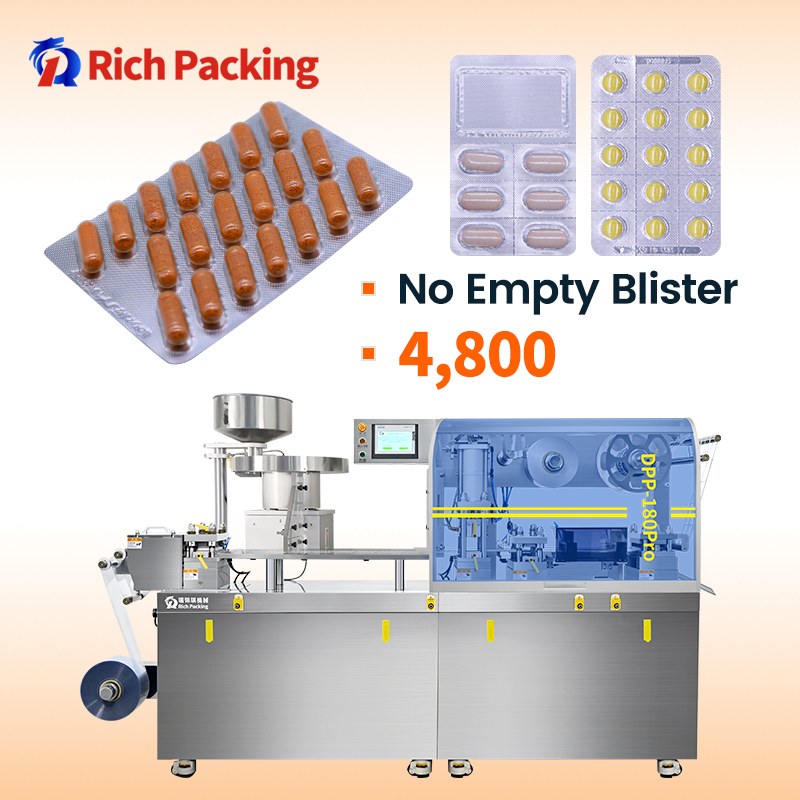
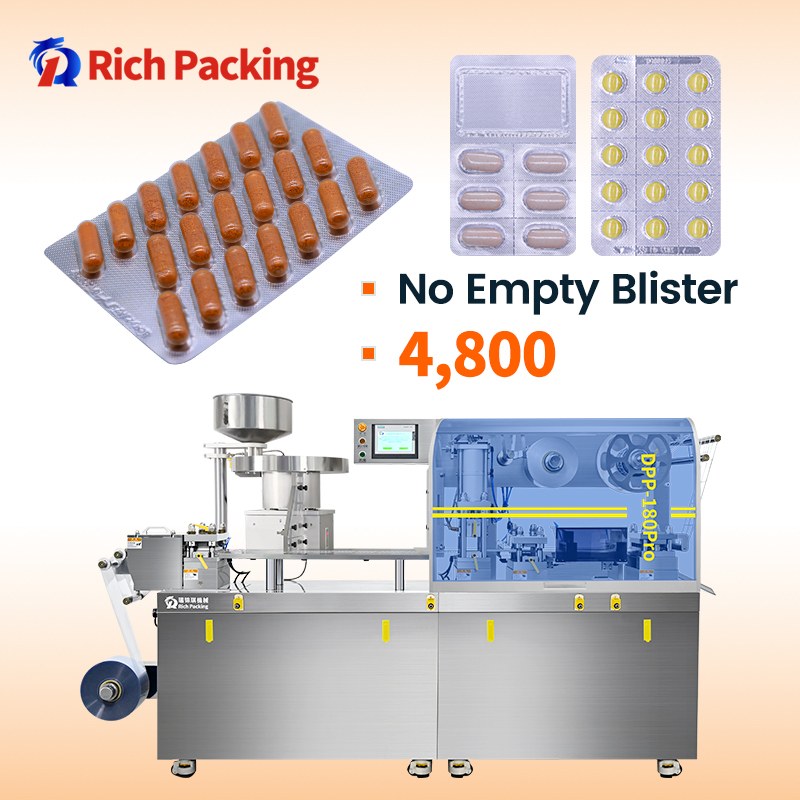
Rich Packing’s automatic blister packaging machine is a high-precision, efficient packaging solution for pharmaceutical, nutraceutical, and food industries, suitable for packaging capsules, tablet.
In the pharmaceutical and nutraceutical manufacturing sectors, the demand for efficient, compliant, and reliable tablet packaging solutions has never been more critical. As production volumes increase and regulatory requirements tighten, manufacturers are seeking high-speed blister packaging machines that deliver consistent performance while maintaining strict quality standards. Understanding the technological innovations and operational advantages of modern blister packaging systems is essential for companies aiming to optimize their tablet production lines.
The Critical Role of Blister Packaging in Tablet Manufacturing
Blister packaging serves as the primary protective barrier for tablets and capsules, safeguarding pharmaceutical products from moisture, contamination, and physical damage throughout their shelf life. This packaging method involves sealing individual doses between a formable plastic cavity and a backing material, typically aluminum or PVC. The process requires precision engineering to ensure each blister maintains its integrity while achieving production speeds that meet commercial demands.
Modern pharmaceutical manufacturing faces several persistent challenges in blister packaging operations. Production bottlenecks frequently occur when equipment cannot maintain consistent speed without compromising seal quality. Material waste becomes a significant cost factor when machines lack precise control systems, leading to imperfect seals or product rejection. Additionally, manufacturers must balance the need for high throughput with strict adherence to GMP (Good Manufacturing Practice) and cGMP standards that govern pharmaceutical production globally.
Technological Innovations Driving High-Speed Performance
The evolution of blister packaging technology has introduced several critical advancements that address traditional production limitations. Contemporary high-speed systems incorporate sophisticated control mechanisms that synchronize multiple operational stages—forming, filling, sealing, and cutting—with microsecond precision. This synchronization is essential for maintaining product quality at elevated production rates.
Flat Plate vs. Roller Systems: Understanding the Architecture
Two primary architectural approaches dominate the high-speed blister packaging landscape, each offering distinct operational characteristics. Flat plate systems, represented by equipment like the DPP Series, utilize a horizontal processing method where material advances in indexed steps. This design provides exceptional versatility, accommodating both Alu-Alu and Alu-PVC format configurations. The flat plate architecture excels in applications requiring frequent changeovers between different product specifications, as tooling adjustments can be implemented with minimal downtime.
Roller-based systems, exemplified by the DPH Series, employ continuous motion processing where forming and sealing occur on rotating drums. This continuous operation enables substantially higher throughput rates compared to indexed systems, making roller configurations ideal for long production runs of standardized products. The rotary design reduces mechanical stress on packaging materials, resulting in more consistent seal quality and lower defect rates during high-volume operations.
Precision Control Systems and Material Handling
Advanced blister packaging machines integrate PLC (Programmable Logic Controller) systems with HMI (Human-Machine Interface) technology to provide operators with intuitive control over critical process parameters. These digital control platforms enable real-time monitoring of temperature profiles, pressure settings, and material feed rates—all factors that directly influence seal integrity and production efficiency.
Material handling innovations have addressed common issues such as misalignment and product damage during high-speed operation. Modern systems incorporate servo motor-driven indexing mechanisms that ensure precise positioning of tablets within blister cavities, even at speeds exceeding several hundred cycles per minute. This precision becomes particularly critical when packaging specialty tablets with irregular shapes or multi-layer formulations that require careful handling.
Integration with Complete Production Lines
The true value of high-speed blister packaging emerges when systems operate as integrated components within comprehensive production lines. Leading pharmaceutical machinery manufacturers design their blister packaging equipment to interface seamlessly with upstream tablet presses and downstream cartoning systems, creating continuous workflow environments that minimize manual intervention.
Guangdong Rich Packing Machinery Co., Ltd. exemplifies this integrated approach through its comprehensive equipment portfolio. Established in 1993 and headquartered in Guangzhou, China, the company has developed a reputation for manufacturing pharmaceutical and packaging machinery that emphasizes high precision and GMP compliance. With a dedicated team of 48 R&D engineers and over 32 years of development experience, Rich Packing (also known as RQ Group) holds multiple invention patents covering critical aspects of pharmaceutical production technology.
The company’s blister packaging solutions, including both flat plate and roller configurations, are designed to work in conjunction with their tablet press machinery, counting systems, and cartoning equipment. This ecosystem approach enables pharmaceutical manufacturers to source complete production line solutions from a single qualified supplier, simplifying validation processes and ensuring compatibility across all system components.
Global Compliance and Quality Assurance
Operating in the pharmaceutical sector requires strict adherence to international regulatory standards. High-speed blister packaging equipment must meet requirements established by regulatory bodies including the FDA, EMA, and equivalent authorities across different markets. Compliance encompasses multiple dimensions: material compatibility with pharmaceutical products, validation capability for cleaning procedures, and traceability systems that document every production parameter.
Manufacturing partners that maintain certifications such as SGS, CE, ISO, and cGMP compliance demonstrate their commitment to quality assurance throughout the equipment lifecycle. These certifications provide pharmaceutical manufacturers with confidence that packaging machinery meets the rigorous standards required for commercial drug production. Rich Packing‘s comprehensive certification portfolio, combined with its recognition as a Top 2 Strategic Partner on Alibaba International, reflects its positioning among trusted suppliers to the global pharmaceutical industry.
Operational Efficiency and Service Support
Beyond equipment specifications, long-term operational success depends heavily on responsive service support and maintenance capabilities. High-speed production environments cannot tolerate extended downtime, making rapid technical assistance and parts availability critical factors in supplier selection. Manufacturers increasingly value partners who provide comprehensive service models including pre-sales consultation, customized configuration design, global installation services, and lifetime maintenance support.
The establishment of localized service centers in key manufacturing regions—such as the United States, United Arab Emirates, and Malaysia—enables faster response times and more effective technical support. Rich Packing‘s global service infrastructure, backed by warranty programs extending up to three years and lifetime maintenance commitments, provides pharmaceutical manufacturers with the assurance that production interruptions can be minimized through proactive support.
Strategic Considerations for Equipment Investment
When evaluating high-speed blister packaging solutions, pharmaceutical manufacturers should assess multiple factors beyond base equipment costs. Total cost of ownership calculations must incorporate energy consumption, maintenance requirements, consumable costs, and the flexibility to accommodate future product variations. Equipment that supports rapid changeovers and modular upgrades provides greater long-term value as product portfolios evolve.
Production validation represents another significant investment consideration. Systems designed with validation-friendly features—such as documented change control procedures, qualification protocols, and validation support services—reduce the time and expense required to bring new packaging lines into commercial operation. Manufacturers who partner with experienced equipment suppliers benefit from proven validation methodologies and comprehensive documentation packages that streamline regulatory submissions.
Conclusion: Advancing Pharmaceutical Packaging Excellence
High-speed blister packaging technology continues to evolve, driven by pharmaceutical manufacturers’ demands for greater efficiency, enhanced quality assurance, and improved regulatory compliance. Modern systems integrate precision engineering, advanced control technology, and intelligent automation to deliver the performance levels required in contemporary pharmaceutical production environments. As the industry progresses toward more personalized medicine and diverse product formats, the flexibility and reliability of blister packaging equipment will remain central to manufacturing success.
Selecting the right equipment partner requires careful evaluation of technical capabilities, service infrastructure, and demonstrated experience in pharmaceutical applications. Companies like Guangdong Rich Packing Machinery Co., Ltd., with their comprehensive product portfolios, extensive R&D capabilities, and global service presence, represent the type of strategic manufacturing partners that can support pharmaceutical companies’ long-term growth objectives while maintaining the highest standards of quality and compliance.
Related products
-
FS-V-F240 Injection valve
Contact UsFS-V-F240 series drip-proof valve is suitable for direct injection of lithium battery which can efficiently avoid liquid dropping and hanging.
-
Optimizing Cross Cut Saw MAXCUT F18S+SENSIT 005
Contact UsHigh speed optimization Timber cutting optimizing Cross-cut saw and precision cutting
Automation production line. -
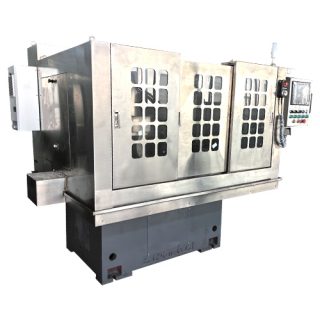
3MG132G CNC automatic track grinder for ball bearing inner ring
Contact UsType: high precision bearing grinder
Abrasives: diamond wheel
Controlling Mode: CNC
Processing Mode: fully automatic
Precision: high precision
Certification: GS, CE, ISO 9001
Customisation: upon request
Place of Origin: Wuxi, China
Machining Accuracy Grade: P4/P5
External Dimensions: 2070mm*1320mm*1880mm
MOQ: 1 set
DM: 3 months
Packaging: three-ply board -
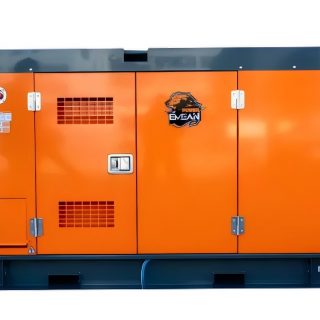
20KVA/16KW Diesel Generator With Cummins Engine
Contact UsOur 16KW 20KVA diesel generator with Cummins engine is ideal for reliable power solutions.
Reviews
There are no reviews yet.