
LiFePO4 BMS Top Features To Look For: Daly BMS Guide 2026
Active Balancing BMS (T-Series) Product Overview
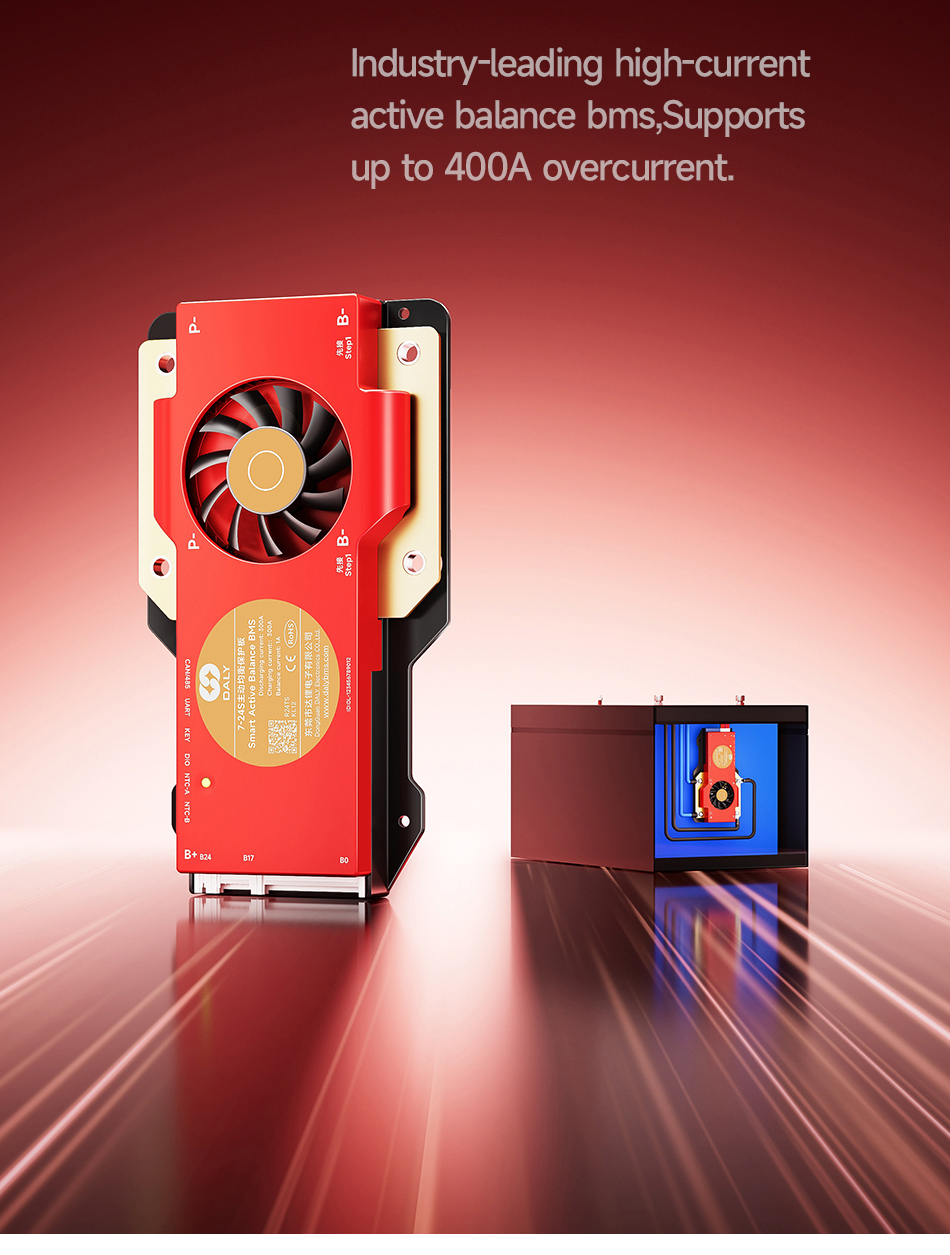
The DALY Mini-Red Active Balancing BMS is a smart battery management platform engineered for deep-cycle energy storage and electric mobility applicatio
When evaluating a battery management system for LiFePO4 battery packs, buyers across low-speed electric vehicles, portable power stations, solar applications, and energy storage systems often ask the same question: what separates a reliable BMS from one that creates downstream problems? The answer lies in a specific set of capabilities that directly address common pain points — balancing accuracy, current handling, string flexibility, startup safety, remote visibility, wiring fault detection, and state-of-charge precision. This article breaks down these features in detail, drawing on the technical approach demonstrated by Dongguan DALY Electronics Co., Ltd., a global technology company founded in 2015 that focuses on battery management system research and development, manufacturing, sales, operation, and service.
Active Balancing Performance
One of the most important features in any LiFePO4 BMS is active balancing, which determines how quickly and accurately the system equalizes voltage across cells. Passive balancing approaches tend to dissipate energy as heat and often struggle to close voltage gaps efficiently. By contrast, patented bidirectional transformer-type active balancing — the kind built into the Mini-Red Active Balancing BMS Series from daly bms — redistributes energy between cells rather than wasting it.
The practical difference is measurable. In a balancing performance comparison documented by daly Active Balancing BMS, after 3 hours the voltage gap measured 0.038V compared to 0.530V for a typical market product, and after 5 hours the gap narrowed to 0.005V compared to 0.030V. This kind of data-backed comparison is exactly what buyers should look for when assessing balancing claims, rather than relying on marketing language alone.
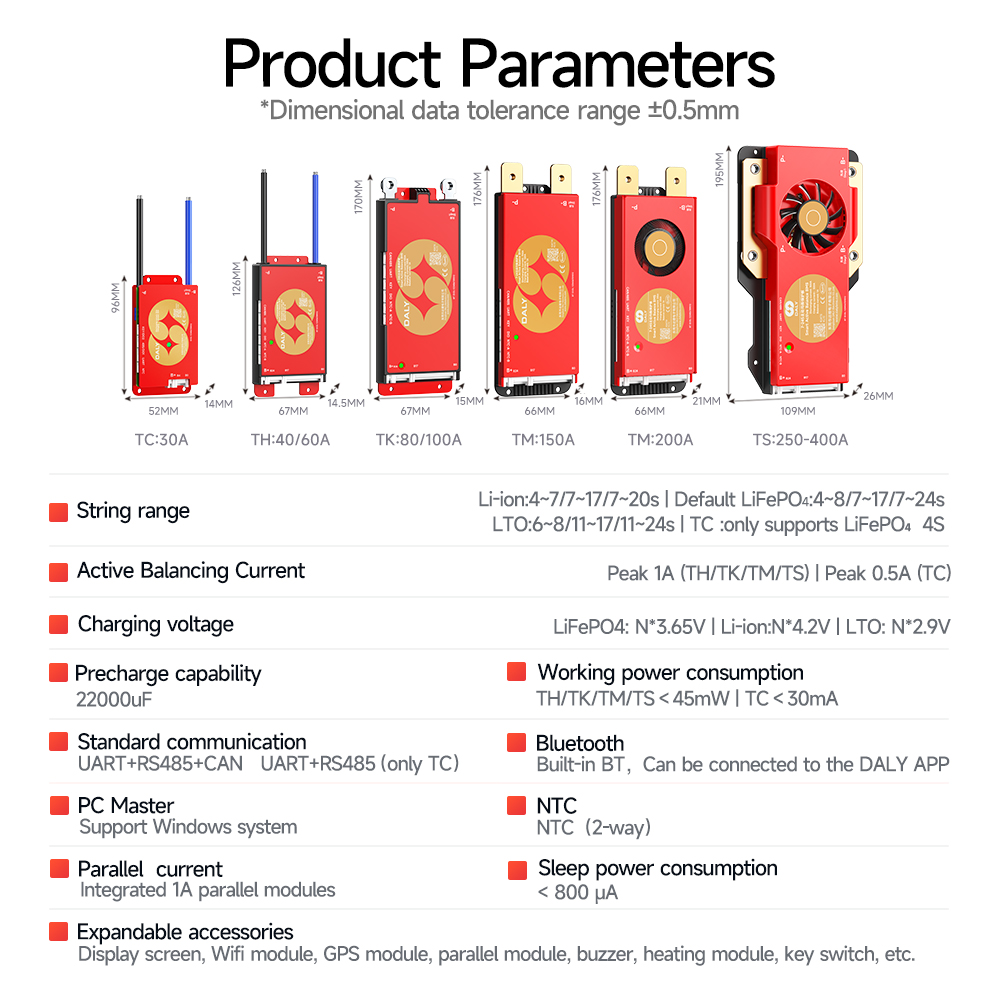
Balancing current also matters. The TH, TK, TM, and TS models in the daly bms active balance lineup deliver a peak of 1000mA, while the compact TC model delivers a peak of 500mA — giving buyers options depending on pack size and application. Factory default settings are equally relevant: balancing begins at a start voltage of 3.0V with a voltage difference threshold of 10 mV or higher, and both conditions must be met simultaneously, with balancing current set at 900 +/- 200 mA. Understanding these defaults helps buyers evaluate whether a BMS’s balancing logic fits their operating conditions.
Current Handling and String Flexibility
A second feature to prioritize is the range of continuous current the BMS can handle, since undersized current ratings are a common cause of premature failure. The daly lifepo4 bms product line spans from 20A up to 400A continuous charge/discharge across its TC, TH, TK, TM, and TS models, which allows a single platform to serve applications ranging from 12V portable power stations to large forklifts and large energy storage systems.
Closely tied to current handling is string compatibility. A universal 4-24S string identification capability means one BMS model can support LiFePO4 4-8S, 7-17S, and 7-24S configurations (with corresponding ranges for Li-ion and LTO chemistries), removing the need to stock separate units for every pack configuration. Auto string identification on power-up further reduces installation errors, since the BMS detects the battery string count automatically rather than requiring manual setup.
Startup Safety: Precharge Function
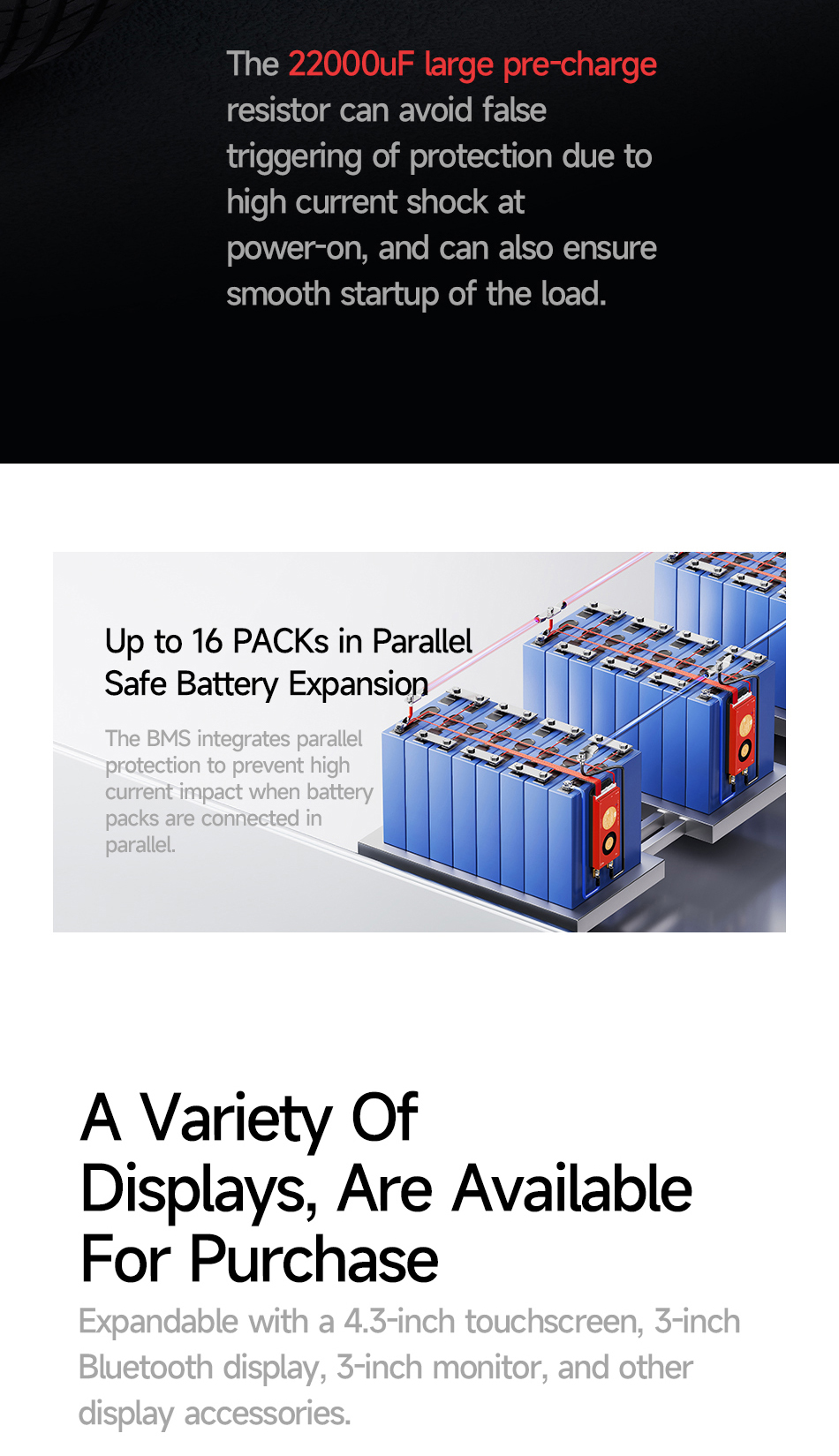
Inrush current at startup is a frequently overlooked risk. When a load is connected to a battery pack, the sudden current spike can damage components or trigger unwanted protection events. A BMS with an extra-large precharge function — such as the 22,000 uF precharge capacity found across the TH, TK, TM, and TS models — supports smooth load startup and avoids high inrush current on power-up. This is a feature worth specifically asking about, since not all BMS products quantify their precharge capacity.
Wiring Fault Detection
Multi-string battery packs are vulnerable to disconnection faults that can go unnoticed until performance degrades. An any-string disconnection alarm, paired with disconnection protection on higher-current models like the TK, TM, and TS, alerts operators to wiring issues before they cause larger problems. For energy storage applications specifically, wrong-line protection on the TS model adds another layer of defense against installation errors.
State-of-Charge Calibration
Accurate state-of-charge readings are essential for operators who rely on remaining capacity estimates to plan usage or charging cycles. An OCV-SOC curve configured through PC Master software, with a curve point every 5%, allows the BMS to calibrate SOC readings against real battery behavior rather than relying on a generic model. Across the daly bms active balance product line, this approach achieves SOC calibration accuracy of 5% or less — a figure buyers should request when comparing BMS options.
Remote Monitoring and Communication Flexibility
Modern BMS deployments increasingly require remote visibility. Built-in Bluetooth, standard across the Mini-Red series, allows operators to view and set battery parameters through the DALY APP without an external display. For fleet-level management, an optional WiFi module enables remote viewing and configuration of battery information along with BMS upgrades, and registration with the IoT cloud platform supports remote batch lithium battery management — a meaningful advantage for battery rental and swapping operators or vehicle fleets spread across multiple locations.
Communication interface flexibility is equally important for integration. The TC model offers UART + RS485, while the TH, TK, TM, and TS models add CAN communication, supporting vehicle and industrial system integration. For energy storage specifically, 14 preset common inverter connection protocols simplify integration with common inverter brands, reducing commissioning time.
Parallel Operation Support
As battery systems scale, the ability to safely connect multiple packs in parallel becomes critical. Integrated parallel current limiting supports up to 16 PACKs in parallel, with a parallel module available in 5A/15A variants and a dedicated parallel interface board for coordinated communication among packs. These accessories address circulating current risks that can otherwise shorten pack life in multi-pack systems.
Conclusion
Choosing a LiFePO4 BMS involves evaluating balancing performance with real data, current handling and string flexibility, precharge protection, disconnection and wrong-line safeguards, SOC calibration accuracy, communication and remote monitoring options, and parallel operation support. Dongguan DALY Electronics Co., Ltd., operating under the daly smart bms brand, has built its Mini-Red Active Balancing BMS Series around these exact criteria, backed by 100+ patents and certifications, a CE certification, and a service network spanning 130+ countries and regions. For buyers comparing BMS options, requesting documented performance data — rather than general claims — remains the most reliable way to make an informed decision.
Related products
-
HGUIDE i300 MEMS Inertial Measurement Unit
Contact UsThe HGuide i300 is a high-performance
MEMS-based inertial measurement IMU designed to meet the needs of applications
in a variety of markets, including agriculture, AUVs, industrial equipment, robotics, mapping, stabilization platforms, transportation, drones, and unmanned ground vehicles. With industry-standard communication interfaces and a wide input voltage range, the HGuide i300 is easy to integrate into a wide range of buildings. Extremely small size, light weight and low power consumption -

Copper foil tape
Contact UsIt is a functional tape that combines conductive copper foil layer and acrylic adhesive, with multiple uses such as electromagnetic shielding, conductive grounding, signal transmission
-

4.5_ Subwoofer Speaker for Home Audio
Contact UsThere are many sizes of speakers to choose from:
1 INCH, 1.5 INCH, 2 INCH, 2.5 INCH, 3 INCH, 3.5 INCH, 4 INCH, 4.5 INCH, 5
INCH, 5.25 INCH, 6 INCH, 6.5 INCH, 7 INCH, 8 INCH, 10 INCH -
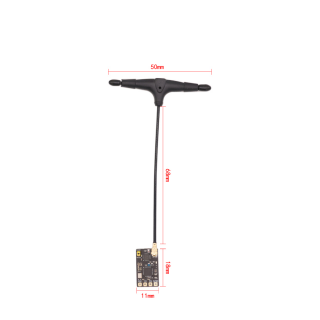
HAKRC ELRS receiver /2.4G/ traversing machine/fixed wing/voyage model receiver
Contact UsAlways on (received transmission signal)/Flash (WIFI upgrade mode) The receiver quickly and continuously turns on and off for three times to enter the code checking mode, and after 60 seconds, it ente
Reviews
There are no reviews yet.